Whatever a laboratory specializes in, it must operate in a controlled environment to ensure both the success and safety of the facility. Optimal laboratory design therefore extends to the flooring used in it, too. It has many properties from slip and chemical resistance to anti-microbial and bacteriostatic attributes, such factors become part of a laboratory’s construction and efficacy.
Choosing the right material that’s best suited to your laboratory speciality is a hugely important decision.We’ll take a look at laboratory flooring, with a closer look at the different varieties and their respective properties.
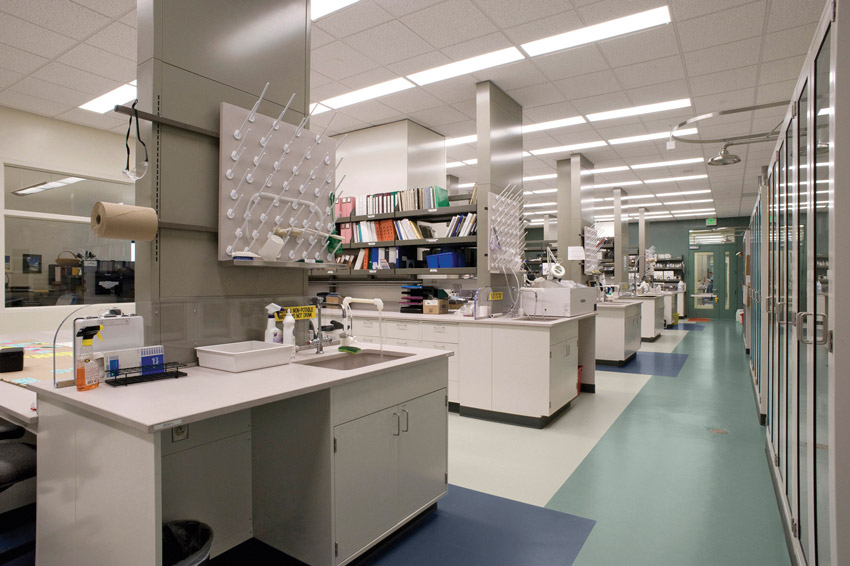
Properties of an Ideal Lab Flooring
An ideal lab flooring must be able to withstand a lot of abuse. It must not only be strong enough to bear the weight of heavy lab furniture and storage solutions and machines but also be impervious to chemical and biological hazards. To be precise, lab floorings should have the following properties.
Solid Footing
Any lab floor is bound to experience frequent pedestrian and traffic. As such, it should be quite durable and must not wear out with time. Also, the lab floor should have a good frictional surface that would be resistant to slip whether dry or wet. Providing an amount of traction is a big deal for any good lab flooring.
Chemical Resistance
This should go without saying, but most laboratories deal with a lot of chemical substances. Which is increased a hundredfold when it’s some sort of a chemistry laboratory. And where there are chemicals, there is spillage. It doesn’t have to be very strong acid to damage a normal flooring ‒ even normal detergent can damage it.
Don’t get misguided by an assumption of crew efficiency. That it can be wiped off fast is not good enough to resist the corrosive effects of a chemical spillage. It is critical to check any test data for the type of flooring you’re buying for your lab ‒ and match it with the concentrations of the chemicals you will be using in the lab.
Lab Floor Finish
Lab floor finishes can be quite effective against chemical spills ‒ but do mind which type you are getting. One type of lab floor finish acts as a sacrificial layer such that it reacts quickly with the chemical.But it will have to be replaced immediately, of course. Another type of lab floor finish acts as a barrier between the spill and the flooring material, preventing any corrosion. But, if they ever get even a hairline crack due to other reasons, the spill will seep through them and slowly damage the floor below.
Biohazard Resistance
Especially for microbiology laboratories, a lab flooring should also be neutralizing to biological elements like various microbes. Therefore, it should have some strong anti-microbial properties. It can also have bacteriostatic or antiseptic abilities, killing and preventing bacteria from reproducing.